Sunday, 30 March 2014

Thursday, 27 March 2014
Initial Shot List
Below is the shot list based on our original storyboard. This may change overtime, although any changes will be reflected through updating the post. The shotlist will be helpful during both the production and post-production stages of developing our product, because it gives a more straight forward view of what each shot should look like than the more detailed storyboard, which also takes into account factors such as Mise-en-scene and the role of actors.
1. Close up of Jess' feet walking through a classroom.
2. Midshot of her body and possibly face to show that it is a girl.
3. Establishing shot of Sophie outside, waiting around the corner for Jess to arrive.
4. Close up of Jess opening the door one side.
5. A match on action cut to a long shot of her walking out of the door the other side.
6. A cut to a midshot the video being watched by Jess in her bedroom.
7. Close up of the video to show more detail about the video, its title, who uploaded it etc.
8. Close up of her phone as she receives a text message.
9. Another close up of the phone as she responds to the text.
10. A midshot of her watching a video from when the two girls were friends.
11. Slightly closer zoomed in shot to show her uploading the video to YouTube - putting the shot closer in represents her sinister intentions.
12. Close up shot of the video being played on YouTube, zooming in through the Ken Burns feature of iMovie until nothing is left of the shot apart from "Back At Ya" - the title of the film.
Whilst there will also be titles for the institutions, cast and crew, these shots are what will make up the basis of the film, so it is incredibly important that we shoot them as well as possible because they will be the part which is most difficult to go back and redo at a certain date, especially as we will only be redoing certain shots.
By George Martin
1. Close up of Jess' feet walking through a classroom.
2. Midshot of her body and possibly face to show that it is a girl.
3. Establishing shot of Sophie outside, waiting around the corner for Jess to arrive.
4. Close up of Jess opening the door one side.
5. A match on action cut to a long shot of her walking out of the door the other side.
6. A cut to a midshot the video being watched by Jess in her bedroom.
7. Close up of the video to show more detail about the video, its title, who uploaded it etc.
8. Close up of her phone as she receives a text message.
9. Another close up of the phone as she responds to the text.
10. A midshot of her watching a video from when the two girls were friends.
11. Slightly closer zoomed in shot to show her uploading the video to YouTube - putting the shot closer in represents her sinister intentions.
12. Close up shot of the video being played on YouTube, zooming in through the Ken Burns feature of iMovie until nothing is left of the shot apart from "Back At Ya" - the title of the film.
Whilst there will also be titles for the institutions, cast and crew, these shots are what will make up the basis of the film, so it is incredibly important that we shoot them as well as possible because they will be the part which is most difficult to go back and redo at a certain date, especially as we will only be redoing certain shots.
By George Martin
Wednesday, 26 March 2014
Organisation of sound
Our film is going to use both diegetic sound, which will be captured by a microphone which is attached to the camera, and non-diegetic sound, in the form of an original song written and performed by our friends and some voiceovers.
Diegetic Sound
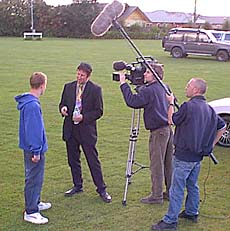 |
| On a larger budget, we would be able to use a boom microphone to capture the diegetic sound, rather than using a standard dynamic microphone like we had too. |
We plan to capture the diegetic part of the soundtrack live along with the action, as this will look much better and will be easier to do than recording the video separately and then overdub it with sound which is recorded later. This would be more difficult to do because the sounds in the film, for example the sound of the phone going off would be more difficult to get perfectly in time as the text came through if we were to overdub it afterwards. Additionally, there was no problem with the audio which was recorded as part of the clip, because it was filmed inside which means there was no wind noise to ruin the recording of audio. The only time we had to film outside was to make the YouTube video which is seen near the start of our film, however the wind noise here is almost desirable because we are trying to make it look like poorly recorded camcorder footage anyway, despite shooting it with an expensive camera. Another diegetic sound which needs to be considered is how the microphone picks up the YouTube video within the film, because it will need to be set at quite a sensitive level in order to make it stand out how it should be. Finally, we will probably add an extra sound into the part where the girl gets pushed over through a self recorded Foley sound, as this will add emphasis and excitement to the part.
Non-Diegetic Sound
The main component of the soundtrack of our film is going to be an original song written by two of our friends, Connar and Morgan. I take A-level music technology so I am going to produce the recording myself, as this way I will be able to get the right feel to the song from the performers, which is a slow acoustic ballad which allows the viewer to reflect on the emotions which are being conveyed within the film. Additionally, self producing the recording means that myself and Jack can change the speed of the song and add parts in so that parts of it work more efficiently with the film, as this is what will show that the piece has been specifically recorded for our film. UPDATE: We later decided to instead use a song called Walk This Way by MØ. Below is the email from her record label, Chess Club, confirming our rights to use the song because our film is to be a not-for-profit production.
Dear George and Jack,
We would be happy for you to use the recording, so long as your video isn't being produced for money, or the song is used in further projects without seeking permission in due course.
Yours sincerely,
A&R Team
Chess Club Records
Additional non-diegetic sounds within the film are overdubbed voiceovers of the girls reading out the text messages which they send to each other, which I am planning on recording at home using a microphone plugged into a computer - these will give a much better quality of voiceover than if we were to record the voiceovers using the microphone which is built into the camera.
Dear George and Jack,
We would be happy for you to use the recording, so long as your video isn't being produced for money, or the song is used in further projects without seeking permission in due course.
Yours sincerely,
A&R Team
Chess Club Records
Additional non-diegetic sounds within the film are overdubbed voiceovers of the girls reading out the text messages which they send to each other, which I am planning on recording at home using a microphone plugged into a computer - these will give a much better quality of voiceover than if we were to record the voiceovers using the microphone which is built into the camera.
Considering the different uses of sound in our piece has shown not only the large amount of equipment which will be needed, but also shows how we could improve the sound if we were to make it on a larger budget.
By George Martin
Tuesday, 25 March 2014
Final Casting Decisions
Rachael: Jess Carroll
Rebecca: Sophie Grimble
Sam: Kurtis Brampton
By George Martin and Jack Jolly
Rebecca: Sophie Grimble
Sam: Kurtis Brampton
By George Martin and Jack Jolly
Monday, 24 March 2014
Final Mise Decisions
Before shooting the film, before the actors required for the shoot got to the location that we were filming in, we had to set up the Mise En Scene of what would be seen in the frame of the film and make sure everything was prepared to create Back At Ya.

This is the main area of our film. The desk at which the computer, the central prop in our film opening is placed. We used feminine lamps, make up items and decorations to create a more typically 'girly' desk for our main character to be seen at. We made sure the desk was in the correct positioning so there was no light glare and so we could get a shadow, to connote the dark, gloomy theme of our film opening.

This close up shows some of the items we used to create the feminine desk set up. I was in charge of set design and had control of the Mise En Scene so I chose some items that weren't over the top, seeing as our main character Rebecca isn't a extremely feminine character, in contrast to Rachael. White's and pale pinks are the main colours of these items which matched the look I was envisioning for the framing area of the location we were filming in.
 This image was when the Youtube channels we created for each character were being made. We did this to increase the verisimilitude for our piece and create a realism about our characters. Our film opening is about cyberbullying so it is essential for social networking sites to be set up for our characters.
The central theme of our film is abusive videos being uploaded and it is the grounds of our plot so Youtube channels are an important part of our media piece.

Camera placement was an important part of the shoot which I took time figuring out so we could achieve the best natural light when filming and feature some of the best angles properly. Due to our main character being a bully victim I positioned the camera to film 'Rebecca' in a high angle to show her vulnerability and depressed character. Also I had to make sure everything was visible in the frame that we wanted to include in our film, otherwise some of our props may have gone to waste. Also important was the working space, I was concerned that we may not have enough space to film and this would be obvious in our final product but after moving some things around we had ample filming space.

Prior to the shoot we showed our actresses everything we had done for the film opening, including taking them through the Youtube channels, telling them the story and the characters motives and the overall plot so they had a better understanding of it. We also recorded voice overs from both of our actresses which were crucial to the storyline because we wanted to use their voices to read out their own text messages. To do this we used Logic X and a microphone and showed our actresses what they had to do.

We both share each task and have an equal role in filming and editing aspects, to get the best possible product. We filmed each clip 3 times so when we come to editing and piecing our film together we have more choices for our film is we notice something wrong with the clip. This will make it easier to create a film without having to worry about re-takes and re-shooting some things later on.
The importance of doing this shoot was to achieve our film opening that we had put a lot of hard work and planning into. Doing this post shows how well we planned our piece and the effort we put into creating a good film opening which we can be proud of.
By Jack Jolly
Saturday, 22 March 2014
Costumes and Outfits for our Characters
 Rebecca, our bully victim, should be wearing quite dark, alternative yet fashionable clothing. Swaying towards an Indie style of clothing, I will create a mock up of an appropriate outfit from clothes on clothing websites. ebecca's outfit consists of clothing found on both the Topshop and River Island website. These dark coloured clothes reflect her character and connote a sense of unhappiness and depression. Clothes similar to these will be easily achievable for our chosen actress. This mock up will help visualise the sort of costumes which is appropriate for our main character. The dark clothing contrasts with the more provocative clothing of Rachael to show a clear contrast between the two characters. Rebecca's dark full-body clothing creates a sense of vulnerability and a lack of self-confidence. This makes her seem more susceptible to bullying and what other people think of her, creating a realistic character for our audience. Black has connotations of sadness and depression which is a correct representation of the character of Rebecca as she is being bullied by people who used to be her friends.
 Rachael's outfit, being our bully, is slightly more provocative without being distasteful. This shows her expensive taste and in-fashion style, portraying her confidence and dominance. The red PVC skirt both displays promiscuity through the material and the colour. Red also has connotations of danger, warning and violence which is an accurate representation of her as the character who bullies Rachael. The extreme juxtaposition between the two characters and their clothing implies the difference between the characters as people. This mock up outfit has been created through items on the Topshop and River Island website as well, the similarity in shops shows the things that the characters had in common when they were friends. Doing this mock up has helped me change certain aspects of the outfits for both characters which might be unachievable or uncomfortable for our actresses to wear. Rachael is more mainstream which is shown through her clothing choices which I have decided, this makes it clear that she clashes with Rebecca in some aspects, perhaps some of the reasoning of why they have fallen out.
 This is mock up of our male characters outfit. This is Sam and he is another bully who joins in to bully Rebecca. I chose another piece of red clothing to connote a sense of danger and aggression and contrast with Rebecca's dismal dark coloured outfit. I have chosen typical slim leg jeans from Topman so he is seen as mainstream and part of the crowd rather than a loner like Rebecca. Vans are also a very common shoe and show that he is just a regular person. Sam doesn't play as much of a big role in the film as Rebecca and Rachael but his outfit is important to show which side he is on. I chose red for both of our bullies on purpose for the connotations and so a clear link can be shown and a clear contrast towards Rebecca. Doing this mock up has helped me visualise how I want Sam portrayed for this short amount of time he is in the film and so the audience can see clearly his role in the film as a bully.
Costumes are an important part of film because it can create a enigmatic persona of a character before they act or speak. Colours and styles can show stereotypes and the sort of person a character is and I have tried to construct outfits which will show the audience that Rebecca is a bully victim while Rachael and Sam are the bullies. When dressing our actors the outfits may change slightly due to what they already have and what we own which we can provide but I will be determined to create a very similar outfit for each character like I have planned on this post.
By Jack Jolly
Thursday, 20 March 2014
Filming Schedule
We plan to do the majority of photography across three days: March 20, March 22 and March 24. Choosing to film on dates which are fairly close to each other means that there will not be a chance to get distracted from the film or forget aspects of it, which will result in a more professional, cohesive product in the end. Below is a plan of shots which we hope to complete on the days.
March 20 - Film the video which is going to make the basis of the film - it is a video of the protagonist being bullied, which is what gets uploaded to YouTube in order to push the bullying further. We are planning on filming this outside on an overcast day in order to make it seem darker with low key lighting, as this will reflect the clearly dark patch of the life which she is going through.
March 22 - This is the day where the bulk of the filming will occur. We will film both interior and exterior shots of the house, and we will be able to dedicate several hours to the filming because it will be on a Saturday. These shots are mainly going to be based around a bedroom in order to show that the girl has resorted to isolating herself because of the bullying.
March 24 - This day is going to be dedicated to finishing off any shots which were not completed or not completed to a good enough standard on the other two days.
Completing this filming schedule will ensure that we have a good level of time management and efficiency when making our shots.
By George Martin
Audtions and Actors
During free periods and lunch times I created audition posters to attract people to our roles which we needed actors for. This was just to create a general attraction for our film, however, I targeted students doing Performing Arts and Drama A Level to ask them personally if they were interested in starring in our film opening. This was because I felt like people who studied acting and performing on stage/ screen could portray our characters as best as can be.
These are some of the potential actors who auditioned for our piece:
These are some of the potential actors who auditioned for our piece:
These are the videos we recorded of people auditioning for our 2 minute film opening. All potential actors did well to recreate a movement or vocal piece we wanted them too but we chose Jessica Carroll and Sophie Grimble for the lead female parts. This was because they fitted the character profiles that I designed better than any of the other actresses but overall because of their acting skills of which they portrayed in their auditions. We felt Jessica was a good actress to play the role of Rebecca because she is a petite female and her display of a dramatic fall was one of the best out of the people who auditioned. Sophie was chosen almost immediately to play the role of Rachael, the bully. This was because of her superb fit to the character profile and the extreme acting abilities she showed when pushing Dani Ellis. Also she is a A Level Drama student so we can rely on her to have more experience than some of the other potential actresses. For the male role of Sam, the other bully, we didn't go with either Ryan or Kieren but with Kurtis Brampton who auditioned at a later date. Unfortunately we don't have video evidence of his audition but his acting abilities and fit to the role won him the part.
We thought auditions were the best idea rather than asking specific people because it would attract people who actually wanted to participate, so we knew we could rely on them. Now we have chosen our actors the filming schedule will be put to them and we will begin filming Back At Ya, which will feature our actors portraying their characters.
By Jack Jolly
Wednesday, 19 March 2014
Photographic Storyboard
Our photographic storyboard differs from the paper one because of the fact we made creative changes during the process. We believe we have changed it for the better and the final product will benefit from it.

 Each picture represents a scene in our film and we had to make do with the scenery and props we had but each scene resembles an idea of what we want and some things will be replaced. We will be using an Apple iMac instead of the school computer and there will be something on the screen each time narrating what is happening in our film opening. The screen will be showing our protagonist turning into an antagonist and posting hurtful videos on Youtube. All of our scenes are very accurate and I believe we have executed this well and hope it is understandable.
by Jack Jolly
by Jack Jolly
Explanation as to the lack of script
Our film opening doesn't contain a script, because the characterisation is built up through the use of other actions - there is no actual direct contact between the two female protagonists seen within the opening, instead the audience only get to see YouTube videos which have been produced of the two of them, meaning that they are given time to make their own minds up. In this respect, not having any dialogue is a better way of keeping the audience impartial to the opposing characters of the two girls, because the Hypodermic Needle theory suggests that the audience will be influenced into liking or disliking a character for the entirety of the film based on its opening, and will perhaps take this dislike of the character away from the film and into their actual life. It is because of this that we have opted to not include any dialogue, and thus no script, in our opening.
By George Martin
Tuesday, 18 March 2014
Considering Actors to Audition
For the role of Rebecca, we have auditioned:
Amy Temple
Katie Pridige
Roisin Sterne
Harriet Sorrell
Ella Redden
For the role of Rachael, we have auditioned:
Sophie Grimble
Catherine Warner
Olivia Pridmore
For the role of Sam, we have auditioned:
Liam Willett
Lewis Hale
Elliot Deemer
Rhys Willett
Amy Temple
Katie Pridige
Roisin Sterne
Harriet Sorrell
Ella Redden
For the role of Rachael, we have auditioned:
Sophie Grimble
Catherine Warner
Olivia Pridmore
For the role of Sam, we have auditioned:
Liam Willett
Lewis Hale
Elliot Deemer
Rhys Willett
Health and safety whilst filming
There are a multitude of different issues to consider in terms of health and safety whilst filming:
- We need to ensure we get permission from the owners of land and houses to ensure that we can film on their property, as otherwise they could halt the filming which would badly affect the film.
- We need to consider issues such as traffic and the public when we are filming outside - as these things out of our control, we need to find ways to get around them safely.
- Ensure that we keep the camera protected by not filming in dangerous places or in the rain.
- Set up equipment such as tripods and dollies on flat, dry ground, again to protect the camera.
- We need to make sure that the general public are treated with courtesy to ensure that they do not complain about us to the school.
- Ensure our actors are aware of the tripod and camera cable to ensure they don't trip over it, which could damage both them and the camera.
- Don't spend too long filming each scene, because this could cause the actors to become tired or frustrated, which is not only bad for them but will also mean that our film suffers because of it.
- Finally, we need to ensure that we don't film anything in public which could be construed as being a weapon as this could land us in trouble.
By George Martin and Jack Jolly
Monday, 17 March 2014
Post on Mise-en-scene consideration
It is incredibly important that we consider the various elements of Mise-en-scene when making our opening, as this is how the majority of the representation of the various characters and themes will be formed. Whilst we cannot be expected to consider it as much as it would be in an ideological TV drama such as the ones which we study for the G322 exam, there are a variety of factors which we need to include in order to represent out characters in a certain way.
Costumes: The costumes are how the instant contrast between the characters is going to be created. For example, one girl is going to be wearing dark, black colours to express her withdrawal and shyness, as opposed to the bright clothing of the other girl. Even little things like this add a huge amount to our film, as they allow the audience to instantly place the girls into a certain archetype.
Lighting: The lighting needs to be lighter when the bully is the focus of the camera, and then darker and more low key when the girl who is being bullied is on the camera. This is because high key lighting connotes happy thoughts, and the bully is obviously going to be more happy than the girl who is being bullied.
Props: The props need to. Be used mainly to show the wealth of the girls - despite the girl who is being bullied clearly being well off, she still seems to be unhappy with life because of the breakdown of her friendship. This could be interpreted as making points such as money cannot but happiness, and it is representational points like this which are key to include in the opening.
Considering these various aspects of Mise-en-scene have shown us the different ways in which we can represent things within the opening, as just a slight change in some of them could present the. Harassers and ideologies as being completely different.
By George Martin and Jack Jolly
Sunday, 16 March 2014
Initial Hand Drawn Storyboard
 $
$

These three pictures show our initial hand drawn storyboard - whilst our final film opening didn't look entirely like this, it does feature all of the same shots, it was just edited into a slightly different sequence. This was a very useful thing to have with us whilst filming, because it contained information about the movement which we had to include in each shot, for example the zooming in on the computer screen and the panning direction which is drawn on the shots which happen outside. Additionally to this, it gave us the timings which each shot needed to run for whilst we were editing, which was incredibly useful in keeping the film concise and not letting shots run for longer than they needed too.
By George Martin and Jack Jolly
Saturday, 15 March 2014
Location Scouting
There are two main locations which we need to scout out in order to film our film opening: a school corridor, and a bedroom. However, there are also a number of other exterior shots which need to be done in order to establish certain locations.
Bedroom: The bedroom we choose to film in is incredibly important, because every single decoration and prop within it needs to be significant of not only a girl, but also of the state of mind which the girl is currently in. It needs to have space for a desk on which we can put the computer, another crucial prop within the opening. Below are some ideas of bedroom designs which we could put into place within the opening.
Exterior house: Whilst this location will only be seen in one shot within the opening, it is incredibly important to choose a house which reflects the mindset of Rebecca within the film. It needs to be a detached house in order to reflect how she feels detached from the rest of her peers around her. Additionally, it needs to be in a suburban area, because otherwise it will not look like a realistic place for her to live. Below are pictures of a couple of houses in the local area which I think we could use for the exterior shot.
By George Martin
Corridor: This can probably be filmed within our school, as it only makes up a small section of our two minute opening. However, the main issue with this location is going to be finding a time when it is quiet enough to film in without background noise, which would make the dialogue within the scene hard for the audience to hear, despite it being crucial in building the characterisation of the three protagonists of out piece. Below are pictures of a couple of corridors which we could use in order to shoot this part.
 |
| Pros: This hallway is clearly well kept and brightly decorated, which could suggest that the school she goes too is a good one meaning that this case of bullying is rare. Cons: It is a fairly small hallway to set up camera, microphone and actors in, so the motion may have to be reduced. |
 |
| Pros: This hallway is much bigger, and the shadows which come in from the window could be used for some interesting cinematography. Cons: It isn't as aesthetically pleasing as the other hallway, meaning that we would have to change certain parts of it in order to be representative of what it needs to be. |
Bedroom: The bedroom we choose to film in is incredibly important, because every single decoration and prop within it needs to be significant of not only a girl, but also of the state of mind which the girl is currently in. It needs to have space for a desk on which we can put the computer, another crucial prop within the opening. Below are some ideas of bedroom designs which we could put into place within the opening.
 |
| Pros: The bedroom does not have much design and is fairly neutral, meaning that we can design it in any way we see fit. It also has a desk, which is necessary for the majority of our filming. Cons: The bedroom seems a bit large and empty for a teenager, although this could also be seen as a pro because of her inner emptiness. |
 |
| Here is the same bedroom from a different angle. |
Exterior house: Whilst this location will only be seen in one shot within the opening, it is incredibly important to choose a house which reflects the mindset of Rebecca within the film. It needs to be a detached house in order to reflect how she feels detached from the rest of her peers around her. Additionally, it needs to be in a suburban area, because otherwise it will not look like a realistic place for her to live. Below are pictures of a couple of houses in the local area which I think we could use for the exterior shot.
 |
| Pros: This is a detached house, which could be used to reflect her detached state of mind. I also like the colour of it, because it is neutral and unaffected - it contrasts with the personality of the girl. Cons: The most obvious con is that the house looks like a manor house, yet the girl goes to a comprehensive school. This clash could undermine the whole film, so it is important to find a way of making it realistic. |
 |
| Pros: It is smaller than the other house, and is also easier to locate in order to film outside. It is still a detached house, which is a necessity when making our film. Cons: There are only a few windows in the house, and since interior shots will be done in a different location, which means we will need to make sure we don't shoot in a room where the view out of the window will make it obvious that we are filming in two different locations. |
By George Martin
Friday, 14 March 2014
Why we chose our film title
We have chosen to call the film Back At Ya. This is because it has a multitude of different intepretations, which means that different audiences will watch the film expecting different things. Providing that we include a representation of all of the different connotations which the title could have, using an ambiguous title like this one will help to attract a larger audience.
The most obvious connotation of the title is one which gives a sense of retaliation towards somebody. This is the main theme of the film, because it is a film about how a girl attempts to overcome her bullies by bullying them back - she's fighting fire with fire.
However, a different connotation of the title which has to be considered is the idea that somebody is going back to somebody that they used to know. This is a potential ending for our film, yet is a fairly different interpretation of the title, so including this idea within it would give the title a much rather reaching appeal.
In short, we have chosen this title because not only is it punchy and catchy, it attracts a youthful audience through a use of slang, and has multiple connotations of meaning, which is sure to attract a wider audience to come and see our film.
By George Martin
Thursday, 13 March 2014
Running order of titles
Here is a visual representation of the order in which our titles will run. I chose to represent it as a video, as not only does it give a better representation of how the titles will flow into each other, it also allows more accuracy with the timings of the titles, because I can see how long each title is, and then elongate it or make it shorter. It also means that I can digitally copy and paste the titles into the final film and retain their order and timings - this would not have been possible without making the titles in Final Cut prior to the post production of the film. I followed the industry standard order of titles, with my actors names before the crew names, as this will make our film opening look as professional as possible. Despite myself and Jack being the ones who are doing all of the crew based jobs, from costumes to directing, I decided to include the names of other people, in order to make the title sequence seem more realistic, as no real film would contain titles which contain the same person for each crew role.
Additionally to this, I added in some extra actors who don't appear in the opening, because if we were making a whole film, there would no doubt be many more supporting actors than the two who appear in the opening.
Organising the running order of the titles has greatly helped, because I can use these exact titles in the production of the film, and just change the fonts - I will already have the correct timings and order.
By George Martin
Tuesday, 11 March 2014
Final Choice of Institutional Logo

We decided to use Jack's logo as our final logo which will be featured at the beginning of our film. This is because Jack's logo is a lot more simple, which makes it more appropriate for use at the beginning of an independent film. It also uses the image a lot more effectively than mine, with the only downfall of this logo being the fact that it doesn't show our technical prowess quite as much due to the lack of animation etc.
After considering both of the logo ideas, we are probably going to go with the idea presented by Jack. This is because whilst mine was a good demonstration of our technical skill, Jack's one will suit the type of film which we are trying to make a lot more, so we have settled on this one.
By George Martin
Monday, 10 March 2014
Group Ideas for Institutional Logo
George's -

This logo is the more technically advanced of the two, because it contains animation. However, that does mean that it is not completely fit for purpose as the logo of an independent company, because an independent is more likely to have a logo which is plain white on black, in order to reflect the fact that the film hasn't been produced on a huge budget. Because of this, whilst it may look better, it will perhaps not be as fit for purpose as some other logo ideas.
Jack's -
This logo is the more technically advanced of the two, because it contains animation. However, that does mean that it is not completely fit for purpose as the logo of an independent company, because an independent is more likely to have a logo which is plain white on black, in order to reflect the fact that the film hasn't been produced on a huge budget. Because of this, whilst it may look better, it will perhaps not be as fit for purpose as some other logo ideas.
Jack's logo is a lot more simple, which makes it more appropriate for use at the beginning of an independent film. It also uses the image a lot more effectively than George's, with the only downfall of this logo being the fact that it doesn't show our technical prowess quite as much due to the lack of animation etc.
After considering both of the logo ideas, we are probably going to go with the idea presented by Jack. This is because whilst George's was a good demonstration of our technical skill, Jack's one will suit the type of film which we are trying to make a lot more, so we have settled on this one.
By George Martin and Jack Jolly
Sunday, 9 March 2014
Group Research into Independent and Mainstream logos
Mainstream:
The logo for Universal is one of the most well known logos of any institution throughout the world - it has been at the start of countless films. It is also a lot more complicated than many logos, due to the complex animation which is involved. This is typical of a mainstream institutional logo - a lot of money would have been invested into making the film as flashy and engaging as possible, so the logo has to match this. Being an independent company, we are unlikely to design a logo like this, because not only would we not have the money to be able to afford the expensive graphics design expertise necessary, but it would look out of place at the start of a film which deals with raw, realistic films from the beginning.
Another mainstream institutional logo which is world recognisable is the 20th Century Fox logo. It again features animation which would be completely out of the reach of an independent company, but also features the overstated styling which is a feature of mainstream logos. The font is huge and unmistakable, whereas with the independent logos below, the use of text is quite understated and is not immediately recognisable. Another important feature about this logo is its use of sound. The matching soundtrack is as recognisable as the actual logo is, because the two are always heard in conduction with one another. Being an independent institution, we are unlikely to feature sound in our logo - if there is any sound, it will be a single shot sound, rather than an instrumental piece which is set to the entire logo.
Independent:

The HanWay Films logo is a typical example of the logo of an independent company. It is incredibly simple, white text on a black background, with no animation and no music in the background. This could be due to the financial restraints on the company, who can't afford a fancy logo like the ones above. However, it could also be a deliberate stylistic choice, as the company may decide that the artistic content of their films is more important than the logo which precedes the film. The logo for our company, Peacock Productions, is likely to look a lot like this logo, as it is fairly simple to design and render, yet still works well at the beginning of an independent film. Also note that this logo will usually only be on screen for a few seconds, as opposed to the mainstream logos, which are often on the screen for upwards of 25 seconds.

The Film4 logo is a fairly unique type of independent logo. Whilst it is still not as complex as any mainstream company logo, it contains some animation and embedding, which is a lot more than the other independent institutional logo I analysed has. This could be because Film4 films are usually relatively large budget compared to the rest of the independent film market, so they have the money to be able to design a logo which is more comparable to the mainstream institutions which dominate the market.
After looking at both independent and mainstream logos, I have realised that whilst mainstream logos can draw in a larger audience for a film, an independent institutional logo would not only be much easier to make, but would also suit a film in the drama genre much better, as a flashy logo would look out of place at the start of a film which is going to likely be about dark themes.
By George Martin
Saturday, 8 March 2014
Description of characters within our opening and hypothetical casting of celebrities to play them
Our storyline features a female protagonist who is 16 years old, our film will feature her, two high school bullies in the year above her and the male bullies girlfriend who intervenes.
 Rebecca - A character who is around 16 years of age, meaning that she is in year 12 at school. She had previously been friends with a group of people who were a year older than her, but this all turned sour in events previous to the film, which will be shown in flashbacks throughout the film. In terms of complexion, Carrie is a light brown haired girl with pale skin. She is generally quite quiet, which obviously reflects the nature of her bullied character. However, the main perspective of the film is that Carrie goes from being a victim of bullying to becoming a bully, in a form of revenge - in this respect she is the protagonist of our film.
We think someone like Taissa Farmiga could play Rebecca really well because of her impeccable acting skills as a bullying victim in American Horror Story and her wide variety of acting skills as playing a more sinister role in The Bling Ring. We well need both of these qualities because our character, Rebecca, will start becoming a cyberbully to get back at her ex-friends who make her life a misery in school. Farmiga fits the role perfectly with her youthful looks, light coloured hair and pale skin. We may be an independent company but Farmiga isn't an A-Lister celebrity so she could be affordable with our storyline which doesn't require a great deal of special effects or props. Having at least one fairly well known face makes our film more likely to draw in an audience and it is a risk we would be willing to take, even if it pushes our budget slightly higher.
 Rachael - 17 year old who was formerly the best friend of Rebecca, and is now the one who leads the bullying against her. She is in many ways the opposite to Rebecca - she has blonde hair, possesses a more attractive figure than her. She is aggressive, spiteful and talkative throughout the film, which means that the audience will recognise her as being the main antagonist within it.
Rachael will be portrayed by a lesser known actress because her strong character can be a break-through for a aspiring actress and it will cost Peacock Productions less. Juno Temple will be playing Rachael due to her natural blonde hair and portrayals as headstrong characters in Wild Child and St. Trinians, both films feature her as a school girl so her role in our film will be believable to the audience. Temple's acting abilities are unquestionable due to her being awarded the EE Rising Star award at the 2013 BAFTAs, as voted for by the British public.
 Sam - Sam is also in the same year as Rachael but is already 18 due to his birthday being a lot earlier in the year than Rachael's. He is second in command in the group of people bullying Rebecca because of our next character, Angel, his girlfriend who is in the same group as Sam and Rachael. He doesn't bully Rebecca as much when Angel is around because of the fact that Angel sympathises with Rebecca because they all used to be friends. Sam does bully Rebecca harshly with words but because of his gender he cannot physically harm Rebecca like Rachael can. Sam is a big character with a hard face and strong sense of humour, he thinks bullying is funny and a joke and is more naive about the consequences than anyone else.
We have chosen William Moseley to play Sam. This is because of his great performance in the Narnia film series, as a lead role character and a cameo in the 3rd instalment of the film series. This shows his acting flexibility and that he is easy to work with. He isn't greatly known since the Narnia film series and has featured in short films such as Don Cheadle Is Captain Planet since then. This means he will be affordable as our independent film industry can only afford minimally known actors. However he has won awards for his acting, for example, his Saturn Award for Best Performance By A Younger Actor. He fits the role perfectly because he is the correct build for our role and would perform the role well.
 Angel - Angel isn't a lead role in the film but still a strong character. She is the girlfriend of Sam and is the person who doesn't participate in bullying Rebecca, she ends up falling out with Sam because of their differences and tries to protect Rebecca from Rachael. She tacky dress sense is a juxtaposition with her kind character and caring behaviour. She is also an attractive girl in the year about Rebecca but she realises that bullying someone who used to be your best friend is wrong.
Chelsee Healey suits the role of Angel perfectly by playing Janeece Bryant in Waterloo Road, a very tacky yet heartwarming character. Healey hasn't had a big role in a film before and our film could be the film break she needs. Because of this she would be cheaper to employ as Angel and would play the role brilliantly as she did as Janeece Bryant.
By Jack Jolly and George Martin
Friday, 7 March 2014
Short Film Brief
A girl is bullied in real life. She tries to retaliate by bullying people online but soon realises she has become the person that she hates.
By Jack Jolly
By Jack Jolly
Tuesday, 4 March 2014
What we have to consider to attract audience members to our film
Our film's main genre is Drama, some of the key conventions of a Drama film are;
- Real life situations
- Realistic relatable characters
- Portrays a journey of character development
- Designed to move an audience emotionally
- Conflict

- Real life situations
- Realistic relatable characters
- Portrays a journey of character development
- Designed to move an audience emotionally
- Conflict
These are just some conventions of a Drama film, however Drama is a specific genre which can be easily interlinked with other sub-genres like Comedy, Tragedy and Romance. Our film is a Coming-of-age Drama which is centred around teenagers lives, aimed at a teenage audience. Films that have influenced ours would be Cyberbully, Submarine and Mean Girls.
Cyberbully starring Emily Osment which was a direct-to-TV based around a main protagonist who is being cyberbullied online. The creators of Cyberbully worked with Seventeen magazine to create and market the film because both products are aimed at a teenage audience. Seventeen magazine's involvement in the film creates a substantial amount of Cross Media Convergence between the two and adds a lot of marketing value to the film.
Left: Emily Osment at the promotion of Cyberbully.
Osment, being a Disney Channel star and famous child actress and singer was a good choice for main character by Muse Entertainment Enterprises because of the buzz from the audience who enjoyed seeing her in Hannah Montana. This would attract an audience who have followed her career from Hannah Montana and other Disney Channel shows and a new audience who appreciate films involving hard-hitting subjects.
ABC created badges that could be added to Facebook and Twitter saying "[Delete] Digital Drama!" to create a social buzz for stopping Cyberbullying from happening. The films purpose was to show how much someone can be affected by online violence which can the film a moral value as well as entertainment value.
Our film is quite a mature film to portray the message about the dangers of cyberbullying, in contrast to other films of the same genre which are created to respect the maturity levels of a teenage audience.
Campaigns for our film would be a good attraction point. Lots of films have campaigns and fans which run the campaigns who are devoted to the projects. As an independent company our budget wouldn't realistically be big enough to start running a campaign but I have decide to search for an independent indie artist who's songs could be good for our piece. The initial idea is to get approval from Sony Entertainment to be able to use Walk This Way by MO in our film opening. Just like Submarine's soundtrack which was performed by the Arctic Monkey's lead vocalist Alex Turner, Back At Ya will feature a song which will be a marketing point for our film opening and create below the line advertising which is a free way of advertising for our film. Music is a good marketing strategy which can be created fairly cheaply, good examples of iconic songs which associate with their films are;
- Over The Rainbow - The Wizard of Oz
- My Heart Will Go On - Titanic
- Come What May - Moulin Rouge
- I Will Always Love You - The Bodyguard
- (I've Had) The Time of My Life - Dirty Dancing
All these songs, plus the amazing soundtrack in Submarine are famous songs from famous films which either attract an audience or directly associate with the film itself. A more modern example would be Pharrell William's song Happy which has recently been used in Despicable Me 2.
By Jack Jolly
Our film is quite a mature film to portray the message about the dangers of cyberbullying, in contrast to other films of the same genre which are created to respect the maturity levels of a teenage audience.
Campaigns for our film would be a good attraction point. Lots of films have campaigns and fans which run the campaigns who are devoted to the projects. As an independent company our budget wouldn't realistically be big enough to start running a campaign but I have decide to search for an independent indie artist who's songs could be good for our piece. The initial idea is to get approval from Sony Entertainment to be able to use Walk This Way by MO in our film opening. Just like Submarine's soundtrack which was performed by the Arctic Monkey's lead vocalist Alex Turner, Back At Ya will feature a song which will be a marketing point for our film opening and create below the line advertising which is a free way of advertising for our film. Music is a good marketing strategy which can be created fairly cheaply, good examples of iconic songs which associate with their films are;
- Over The Rainbow - The Wizard of Oz
- My Heart Will Go On - Titanic
- Come What May - Moulin Rouge
- I Will Always Love You - The Bodyguard
- (I've Had) The Time of My Life - Dirty Dancing
All these songs, plus the amazing soundtrack in Submarine are famous songs from famous films which either attract an audience or directly associate with the film itself. A more modern example would be Pharrell William's song Happy which has recently been used in Despicable Me 2.
By Jack Jolly
Saturday, 1 March 2014
Certification of Our Film
I believe that our film will be certified as a 15. The BFI say that a 15 rated film can contain:
- strong violence
- frequent strong language (e.g. 'f***').
- portrayals of sexual activity
- strong verbal references to sex
- sexual nudity
- brief scenes of sexual violence or verbal references to sexual violence
- discriminatory language or behaviour
- drug taking
All of this suggests that our film will be suitable to be classified as a 15. In terms of violence, we will only feature it in flashbacks to show the tough life that the protagonist used to lead, and even then, it is going to be inferred more than shown. This means that it will probably contain violence which is suitable for a 12A, as violence is not something which we plan is going to be a very large aspect of our drama film.
It is likely that we will use frequent strong language within our film, in order to present a setting which is as realistic for the audience as possible. Whilst we could cut out some of this language in order to allow our film to be watched by a larger audience, we believe that in the artistic interest of our film it would be best if we included strong language where it needs to be included, without pushing the boundary out too far.
The portrayals of sexual activity in our film are going to be minimal or non-existant, because this is a coming of age story which strays away from the sexualised story of being a teenager that most films tell. Instead, ours is a story of leaving childhood behind in different ways, so any portrayal of sexual activity are likely to be very light ones.
There is likely to be some nudity within our feature length film, as we will have to give a portrait of how society believes teenagers live, which may include having to include nudity in our piece, be it in a sexual or a non-sexual way. However, we are unlikely to use it in a way which is overtly sexual, because as I mentioned before, our film is trying to stray away from the sexual promiscuity which seems to dominate the coming of age genre.
In terms of sexual violence, our film will not include any form of rape, sexual violence or any other kind of footage about molesting. Our film will be rated 15 because of other things like strong language and some portrayal of sexual activity between couples.
Our film is likely to include some discriminatory language, as we have different ethnic backgrounds involved in our film. To properly convey the message of the film and to identify key social issues in teenage life in this day and age some discriminatory but not specifically racist language will be evident. However, our film will never encourage this sort of language as being acceptable, and will always portray the characters as being a villain rather than a hero at any point when they are being discriminatory.
Finally, our film isn't likely to include any drug taking. Whilst it is a growing trend in the age bracket of the characters we believe our film is about more of the bullying within the middle class than the lower classes and "chav" society. This ensures that there will be no references to drugs in our film unless it is alcohol or tobacco which aren't seen as 'heavy drugs'.
Thinking about the certification which our film should be has made me consider the possibilities of changing elements of it in order to reach a lower certification, although I believe our film would lose some of its stylistic integretity if we had to cut it in order to make it into a 12A. I think a 15 is the best certification for our film as it will ensure that older audiences feel they can watch it and be entertained my it and will also avoid letting teenagers younger than 15 being intimidated by some of the content.
By George Martin and Jack Jolly
Subscribe to:
Comments (Atom)